
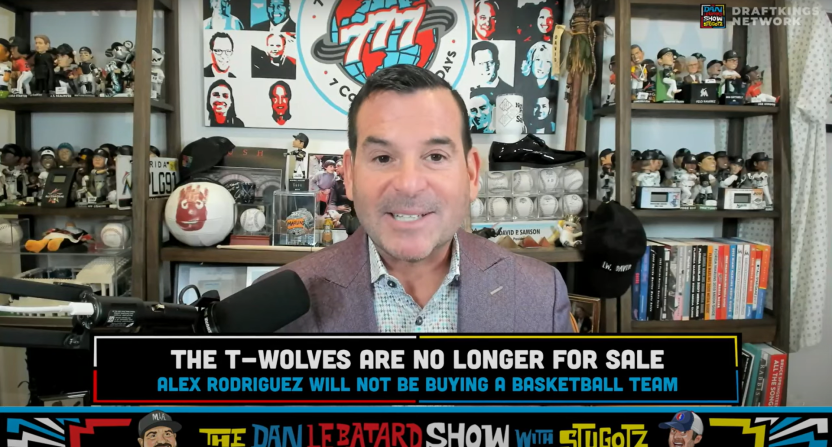
David Samson is a polarizing figure — both inside and outside of the Meadowlark Media universe.
But if anyone needed proof of the value that the former Miami Marlins president brings as a media personality, it came during Thursday’s episode of The Dan Le Batard Show with Stugotz.
Samson was appearing as a guest alongside Adnan Virk to discuss MLB Opening Day as news serendipitously broke that Marc Lore and Alex Rodriguez’s attempted purchase of the Minnesota Timberwolves and the Minnesota Lynx had fallen apart. With that, Samson took off his (metaphorical) baseball hat and put on his business one to explain why the high-profile sale had gone south.
“Let’s take people back, before [Rodriguez] was having a legal practice in Minnesota before he bought a house and pretended he was from Minnesota, he agreed to buy the Timberwolves at a price of $1.5 billion in 2021,” Samson said. “But it was something called a step transaction. A step transaction means you lock in the value today, but you pay over time. And there are deadlines contained within the purchase agreement that you have to make your next installment payment by a certain date. And A-Rod has missed just about every deadline. And [current Timberwolves owner] Glen Taylor has been OK. He said, ‘Hey, we’ll extend the deadline. Don’t worry about it.’
“But, meanwhile, the price of basketball teams have skyrocketed since 2021. So the Timberwolves are no longer worth 1.5. Let’s say they’re worth about 2.5. So that means that Glen Taylor feels terribly when he sold the team at 1.5 when he could have sold it at 2.5. But he was in a contract and there was nothing he could do — until A-Rod missed another deadline… it was all horse hockey. A-Rod had never been able to come up with the money to finish this transaction… if the team is sold again by Glen Taylor to A-Rod, it won’t be for 1.5.”
Asked by Amin Elhassan — who was filling in as the show’s host — why he was so gleeful in his analysis of the sale falling apart, Samson replied, “Because I’ve been calling this for two years.”
How did he know? Based on the Nothing Personal host’s dealings with the former baseball star.
“I negotiated with A-Rod to buy the Marlins. And he had everything except the money, so it would always be an issue,” Samson said. “He wants to be an owner so badly that he pretended that he wanted to be in Minnesota. But he never was able to hit his deadline. And finally, Glen Taylor said, ‘You know what? It’s cool that you’re A-Rod. But money’s way more important.”
Say what you will about Samson, who certainly has a habit of rubbing people the wrong way. But it’s tough to top having a former MLB team president who has personal experience negotiating with figures such as Rodriguez when it comes to breaking coverage of such a seemingly complex story.
[The Dan Le Batard Show with Stugotz]

