

Late last season, somewhere in the crowd at a Panthers-Seahawks game, sat a young man who could have passed for Sam Darnold’s twin. He had the Seattle quarterback’s complexion, his red hair, and his jersey, and after Darnold made a big play, CBS director Andy Freedman found him in the stands and put him on national television.
Within minutes, the shot was all over social media.
This is AWESOME🥹
The fan that looks like Sam Darnold was getting his phone blown up after he was featured on the broadcast 😂 https://t.co/MtTYJE7KJz
— NFL on CBS 🏈 (@NFLonCBS) December 28, 2025
Down on the field, Evan Washburn watched it on the RF monitor a crew member carries beside him every game, a small portable screen that lets the CBS sideline reporter see exactly what viewers at home see. And the longer the moment played out, the more he wanted to know what Darnold would make of his doppelgänger.
“I had in my head, well, I have this RF monitor. If the Seahawks win this game, and we’re doing a taped postgame interview, I’m gonna ask them to put that picture of that guy in the monitor and have Sam be able to react to it live in the moment,” Washburn told Awful Announcing.
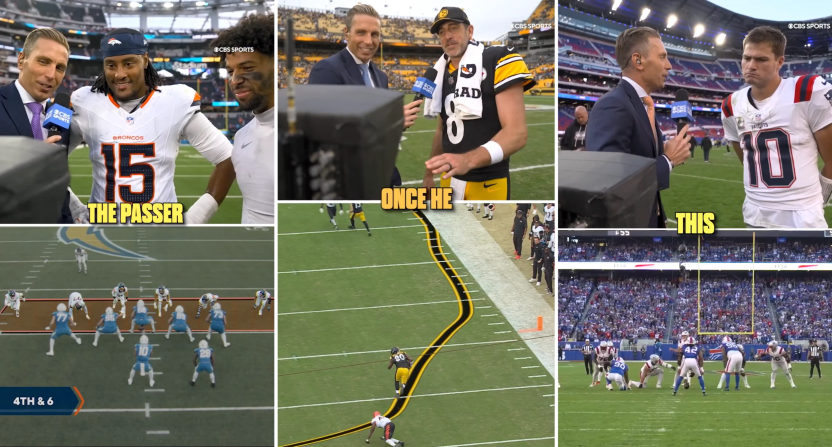
Washburn never got the chance to pull it off, since the game was in CBS’ late window and the postgame interview had to be done live, with time for only two questions, neither of which he was willing to spend on a lookalike. The idea of putting something on that monitor and watching a player react to it never left him, though, and 10 months later, it has become the foundation of the “Instant Film Room,” where every Sunday this season, Washburn has replayed the biggest play of the game for the player who made it and asked him to explain what he saw.
“That, honestly, Sam, that’s where the idea was truly born,” Washburn tells me. “And then over the course of the summer, it probably re-engaged with me when I was watching golf.”
Washburn has fallen hard for golf over the past few years, and this summer, he became fixated on a ritual that football coverage had never thought to borrow. After a round, golf broadcasts routinely usher players to the desk or the interview area and make them relive their shots one by one, picking apart every club selection and every calculated gamble.
“Hey, you had this chip shot on 11. What were you thinking here? Why would you go 3-wood instead of 5-iron? All those things,” Washburn said. “So I kind of was watching golf this summer and thinking, well, why can’t we do that in a postgame interview?”
The rhythm of CBS’s Sunday coverage gave him the breathing room to try it. Because the network whisks viewers from one finish to the next to keep them immersed in what Washburn called “the down to down world,” he tapes most of his postgame interviews rather than doing them live, leaving just enough time to cue a replay and let a player talk through it. The RF monitor that makes it all possible has been a fixture at his side for years, mostly so he can sync his reports with whatever the control room is putting on air.
“So in case I’m doing a report, and I’m talking about Justin Herbert’s ankle, I can see what our director Suzanne [Smith] is showing, so I’m talking more to the pictures,” Washburn said. “But that RF monitor also is there postgame and could show a play. So I think those two things kind of got the idea going, and then we went from there.”
The segment got off to a memorable start in Week 1. Minutes after his 34-yard strike to Josh Palmer with 1:36 left lifted the Bills past the Texans, 36-31, for Buffalo’s first win in Houston since 2006, Josh Allen rewound the throw on Washburn’s monitor and explained that Houston’s safeties had started cheating toward DJ Moore. Then he let viewers in on something most quarterbacks would never volunteer, conceding that the play the Bills had drilled all week had very little to do with what actually happened and calling the completion a “horseshoe.”
“This is not where the ball is supposed to go,” Allen said. “We have never once repped the ball going there.”
“This is not where the ball is supposed to go. We have never once repped the ball going there.”
Josh Allen breaks down the Josh Palmer TD, which gave the Bills the lead late in the game
🎙️: @EvanWashburn https://t.co/SMxQxE7Ti4
— NFL on CBS 🏈 (@NFLonCBS) September 13, 2026
The revelations kept coming.
Bo Nix walked through his 49-yard bomb to Jaylen Waddle in Week 2, the centerpiece of an eight-catch, 138-yard breakout for the receiver Denver pried away from Miami in an offseason trade, as the Broncos snapped Jacksonville’s nine-game regular-season winning streak with a 20-13 win.
That Bo Nix to Jaylen Waddle connection 📈👀
Nix took @EvanWashburn through a big play from Waddle’s breakout performance https://t.co/KKXCUCfy4f
— NFL on CBS 🏈 (@NFLonCBS) September 21, 2026
In Week 3, Aaron Rodgers relived the rumbling 47-yard catch-and-run by his 6-foot-7 tight end, Darnell Washington, that set up Chris Boswell’s go-ahead field goal in Pittsburgh’s 30-27 win over the Bengals, and in Week 4, Drake Maye broke down the 23-yard strike Efton Chism hauled in with one hand on third-and-5 with 1:50 left, the go-ahead touchdown in a 29-26 upset in Buffalo that handed the Bills their first loss and kept the Patriots, who had been sputtering without the injured A.J. Brown, from falling to 1-3.
We showed Aaron Rodgers his big play to Darnell Washington, and his reaction was amazing 🤣
@EvanWashburn brings the @steelers QB into the Instant Film Room 🎥 https://t.co/UhJwcc667V
— NFL on CBS 🏈 (@NFLonCBS) September 28, 2026
We got Drake Maye’s instant reaction to Efton Chism’s incredible catch 🙌
He told @EvanWashburn it reminded him of another @Patriots catch 👀 https://t.co/20ehKzfMDA
— NFL on CBS 🏈 (@NFLonCBS) October 4, 2026
What looks seamless on screen is the work of an entire crew, and Washburn made sure to name every one of them. Producer Ken Mack runs the operation, Suzanne Smith directs, a camera operator everyone calls “Jay-Z” shoots the segment, and Jason Melnick works in the truck. Washburn reserved his highest praise for Ben Fennell, the crew’s Xs-and-Os specialist, who builds the replay graphics that analyst Ross Tucker dissects during games and has become indispensable in deciding which play earns a spot in the film room.
“He’s one of those guys that can see all 22 and pick out exactly what’s happening, but make it visually digestible for the fan and the viewer,” Washburn said.
The selection process begins with the notebook Washburn fills over the course of three hours and reaches its boiling point in the final minutes, when he and Fennell lock in a play for each possible outcome.
“Look, I’m logging the entire game. So if a big play happens, a great throw, it’s going in my notebook. That’s one of the things I just have done for years,” Washburn says. “But then as we get closer, let’s call it under five minutes in the fourth quarter, we’ll start getting on the horn with Ben Fennell and say, hey, I like this play. I wanna get to this play if the Broncos win, or I wanna go to this play if the Chargers win.”
For the first four weeks, the games made those calls for him, each one delivering a game-winning moment so obvious that the backup plans never came into play. But last week’s lethargic slog between the Broncos and Chargers didn’t yield a single offensive snap worth reliving, so Washburn had to turn his attention to the other side of the ball.
“That was a grinder game,” Washburn said. “It was not visually pleasing from an offensive standpoint. So we were kind of painted into a corner a little bit.”
Washburn concluded that Denver had won on the strength of its defense, and that the game hinged on safety Brandon Jones’ interception on the Chargers’ second-to-last possession. He first interviewed edge rusher Nik Bonitto, the marquee name on that unit, before waving Jones over to watch his pick, and the result convinced him the segment doesn’t need star power to resonate.
Before his clutch interception, @Broncos DB Brandon Jones recognized the Chargers’ look from earlier in the game 👀
He broke down the play for @EvanWashburn fresh off the W https://t.co/rouhcKbMj4
— NFL on CBS 🏈 (@NFLonCBS) October 12, 2026
“Bonitto’s a big name, I would say, for football fans. But I don’t know if the common football fan outside of Denver knows who Nik Bonitto is necessarily, and they probably don’t know who Brandon Jones is, but they’re big-time players,” Washburn said. “Yeah, it’s great if you have the A-list player talking about the big-time play, but it still works if you have what I’d call a high-end starter who’s not a star, because the fan is seeing them talk through this critical moment in the game.”
Washburn assumed players would be comfortable with the format, given how much of their week revolves around film. What he didn’t see coming was the flood of emotion the replay would unleash, which he attributes to the fact that most of them are seeing the play for the very first time. The tablets players pore over on the sideline between series show only still images, so the film room offers their first real look at what they just pulled off.
“They spend their entire time not on the field, for the most part, when they’re prepping and working in the building, watching film. It’s where they’re most comfortable,” he says. “And then it’s the first time they’re seeing it, which is my favorite part and what surprised me more than anything, because I thought, OK, well, we’ll do the emotional component of the interview, and then we’ll do a little X’s and O’s on the back end. But what we found is that they’re honestly more emotional, obviously in a joyful way.”
No one illustrated Washburn’s point better than Rodgers. Rather than linger on his own throw, the 42-year-old quarterback, back in Pittsburgh for what he has called his final season, spent much of his segment raving about Washington and pointing out one teammate after another whose block downfield helped turn a short completion into a 47-yard gain.
Jones lit up just as quickly in front of the monitor, watching the fourth-down interception he made at the Chargers’ 41-yard line with 3:26 left and returned seven yards to seal Denver’s 23-17 win, and Washburn said the safety marveled at how cool it was to finally see the play himself. Washburn said the impulse behind those reactions is one every viewer at home will recognize.
“What do we do when something cool happens? We pick up our phone and try and watch it again and again and again,” Washburn said. “So I think we’re playing off of that aspect of it, where this is just how we consume things, and why not bring that to this moment of raw emotion right after a game. … We’re getting this raw, real reaction to a big play for these guys, literally in some cases, minutes afterwards.”
Some of the segment’s best nuggets have slipped past Washburn in the moment. He didn’t catch Maye’s sly remark that the Chism grab was the kind of play Kayshon Boutte — now with the Houston Texans — would make until he rewatched the interview, the jab tucked inside the rapid-fire Southern drawl of a quarterback Washburn described as “such a fun guy,” and he said it was the sort of unguarded aside that only surfaces “while their emotions are still jacked up after a win.”
The segment’s look has been refined along the way, too. In the Allen interview, the camera stayed locked so tightly on the quarterback’s eyes that viewers never saw the monitor he was fixated on, and Washburn credited Smith’s keen instincts, along with his camera operator, for pulling the shot back in the weeks since to reveal the top of the screen.
“For the folks at home, and they consume this on social, or however they get it, it helps to see the top of the monitor so that they see that the player is watching it,” Washburn said.
No player has told Washburn what he thinks of the segment yet, though he is eager to hear from one once a familiar face returns for a second session. The response that has resonated most has come from the film junkies who spend their weeks dissecting All-22 footage, the same exacting audience Fennell comes from.
“If I’m speaking to that audience with this, then I know I’m winning,” Washburn adds. “And then my hope is that the casual fan will enjoy it as well, because they’re seeing these players, again, in a different light.”
Washburn already has ambitious plans for weeks when the winning team’s biggest star isn’t the one who made the play everyone will be talking about. Rather than sacrifice a compelling breakdown just to get a marquee name on camera, he wants to give the star a traditional interview and then bring in the player who actually swung the game. He sketched out how that might look this Sunday, when he joins Ian Eagle and Ross Tucker on the call for Panthers-Eagles, imagining a Carolina win in which Bryce Young, the NFL’s leading passer through four weeks, discusses the team’s torrid stretch and his place in the MVP conversation before Chuba Hubbard steps in to break down the kind of bruising touchdown run in which, as Washburn put it, he “jukes out four dudes, runs over a guy into the end zone.”
“Then when he’s done, we bring in Chuba, and it’s like, you’re here for Instant Film Room,” Washburn said. “You made the play of the day, so you’ve now gotten into the Instant Film Room.”
Pulling in a second player is rarely a problem, Washburn added, since team public relations staffs tend to go out of their way for the network carrying the game. He would love to get an offensive lineman in front of the monitor someday, the kind of big man who barrels out ahead of a screen pass, describing the scenario as “a Jason Kelce type deal.” He has also floated bringing the format to NCAA Tournament postgame interviews, where players already watch video during games and would slide naturally into the concept.
More than any single idea, though, the segment’s early success has emboldened Washburn to keep taking chances, even on one of sports media’s biggest stages.
“Keep trying to do stuff, because the worst thing that happens is it falls flat, and you’re like, all right, well, maybe we don’t do that next time, or we do it a different way,” he said. “Just because it works and what we’ve done works doesn’t mean we can’t try a different angle at it.”
The next great idea could come from anywhere, and the Instant Film Room is living proof, born from a quick camera cutaway to a fan in the stands that was never meant to be anything more than a fleeting bit of fun in a late-season game.
Somewhere out there is a red-headed Seahawks fan who has no idea that his brief cameo on CBS last season changed the way the network handles its postgame interviews, and if Washburn ever catches Seattle on a week with a little time to spare, Darnold might finally get his look at him.

About Sam Neumann
Since the beginning of 2023, Sam has been a staff writer for Awful Announcing and The Comeback. A 2021 graduate of Temple University, Sam is a Charlotte native, who currently calls Greenville, South Carolina his home. He also has a love/hate relationship with the New York Mets and Jets.
Sean writes the Awful Announcing 'The A Block' newsletter every Tuesday Subscribe here.