
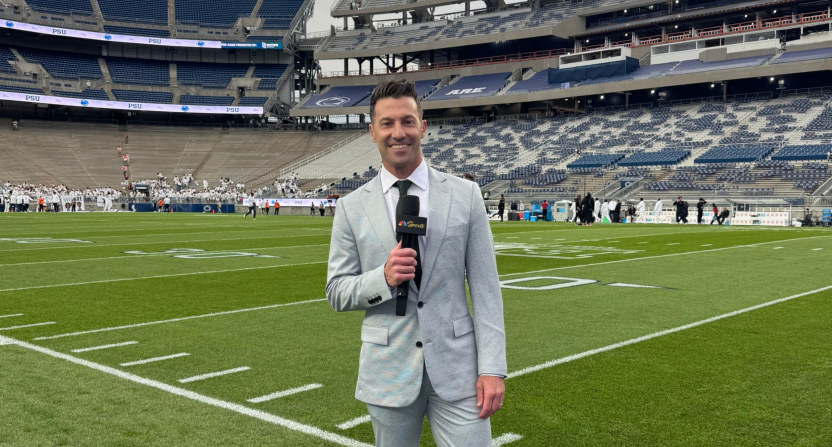

Typed along the bottom of every broadcast board Yogi Roth carries into an NBC booth is a standing order to himself to celebrate the game and coach the viewer.
Roth, now in his 19th year calling college football and his second season at NBC, composed that directive after leaving Pete Carroll’s staff at USC, where he spent four seasons working alongside the Trojans’ quarterbacks. He told Awful Announcing that stepping away from the sideline left a profound vacancy in his life, one he could only reconcile by reimagining the booth as a different kind of classroom.
“When I left coaching, there’s a big void, you know, and I knew what I was leaving at the time,” Roth says. “You may not coach four quarterbacks or 50 guys on offense… but you get to go, coach a couple million every Saturday, and I love that part of it.”
Treating viewers like players in a film session is how Roth approaches the entire job. It explains why he spends Sunday nights alone in his home office building a game plan for a broadcast, and why he’s willing to sit on a well-researched story for an entire game if the action never calls for it.
Sunday to Saturday
Roth’s week officially starts on Sunday, but he keeps football at arm’s length for most of it. Home from the previous day’s game with his wife and two sons, he tries to do as little as possible until around 6 p.m., when he slips back into what he calls his little office and begins building the board for the following Saturday. Rather than poring over individual snaps that night, he sketches a big-picture theory of each team, which Roth refines and occasionally overhauls as the week’s film sessions and phone calls accumulate.
“I’ll kind of go back into my little office and build out my board, start prepping my film cutups, and just trying to stay at 10,000 feet of, all right, who’s playing? What are the staff counts? What are the blitz percentages?” Roth said. “Just kind of shaping what I like to call a thesis entering Sunday night.”
Monday introduces the more granular work. Alongside film and a stack of reading, Roth conducts a pair of phone calls he admits he appropriated from industry veterans roughly 15 years ago, spending about an hour with the sports information director at each school. He uses those conversations to excavate everything beneath the surface, from why a different left guard started in Week 2 to how the fan base is feeling about the season. With that groundwork in hand, he explained, he avoids rehashing the basics with coaches and players later in the week and can make those meetings far more substantive.
Once he finishes his film on the first team Monday, Roth turns to the second on Tuesday, consolidating his notes and supplementing them with analytics research NBC provides to help him anticipate how the game might unfold. On Wednesday morning, the stretch of the week he cherishes most, he leads an hour-long film study for the entire production crew, averaging around 130 plays, outlining the packages and tendencies he wants everyone prepared for on Saturday. He marveled at how invested the crew is in those sessions, noting that producers and staffers routinely arrive with their own ideas before he ever presses play.
By Wednesday evening, Roth has polished his material enough to step away and, in his words, really be dad, attending his kids’ practices and helping coach their flag football teams. He boards a flight Thursday and dedicates the remainder of the week to situational football, scrutinizing late-game and halftime decisions from around the country and discussing several examples with his crew so he can speak with authority on game management. After meeting with the home team’s staff and players, he sits through production meetings, typically Friday night ahead of an early Saturday kickoff, and by 6 p.m. he hopes to be watching a compelling game and FaceTiming his boys before calling it a night.
The Road to NBC
That meticulous routine now serves a network Roth admired long before he ever called a game. He grew up in northeastern Pennsylvania, where NBC’s Notre Dame broadcasts were a weekend staple, helped along by the fact that former Irish quarterback Ron Powlus came from the same corner of the state. Roth said he always held the network in tremendous regard, and whenever he sat down with his representation to talk about potential employers, NBC sat at the top of his list.
That dream only came within reach after the conference that built his career came apart, leaving Roth without a network and with no clear sense of where he would call games next.
Even the ending carried a hint of foreshadowing. Roth pointed out that the final game ever televised on Pac-12 Network featured Notre Dame, the program most closely tied to NBC, in a matchup against Stanford. The following week, he was in New York covering the Heisman Trophy ceremony, as he had for years, and he used the trip to meet with nearly every network in the sport while trying to keep what he called his dream career alive. His conversations with NBC’s leadership went well, but what sealed it was hearing from producers and on-air talent he already considered friends, whose glowing feedback left the network with little convincing to do.
“It didn’t have to be much of a pitch, you know, it was kind of like, the door’s open, what do you think?” Roth said. “And I was all in.”
Once he arrived, NBC made sure he understood how central football is to the network’s identity, and Roth got a firsthand look at what that means this past summer. He traveled to Canton to watch his former Pitt roommate Larry Fitzgerald enter the Pro Football Hall of Fame, and the network invited him to sit in with Cris Collinsworth and Mike Tirico during the Hall of Fame Game broadcast. Watching the network’s flagship crew operate up close showed him how the standards set at the top of NBC’s football operation reach every telecast beneath it.
“To see that model… filter down to every game, every broadcast, every pregame show, that to me was a really cool thing to see,” Roth continued. “I want to be part of a team, and I want to be part of something greater than myself, and NBC is. They set the bar for me when it comes to sports television, especially around football.”
‘What happened to Yogi Roth?’
Roth’s idea of the broadcaster he wanted to become began with Pete Carroll, who asked him that question when Roth was 25 and new to television. Roth told him he wanted to be Kirk Herbstreit, and he now concedes that nearly every aspiring analyst would have offered the same predictable answer.
“He goes, ‘Well, what happened to Yogi Roth?’ And I said, ‘Great question,'” Roth said. “And he said, ‘Go spend the next month and develop your style, your vision, your theme, and your philosophy around how you want to broadcast.’ And I did, and I came back with 36 typed-out pages, and he read it, and he flipped it back, and he goes, ‘Now put everyone in a sentence.'”
The sentence Roth eventually settled on commits him to being youthful, energetic, and honest, with fact first and opinion second. That philosophy explains why he has never chased attention the way some of his peers do, and he connected his temperament to the years he spent on Carroll’s staff, which he likened to earning a PhD from one of the greatest coaches of all time.
“I’m not a screamer. I’m not gonna be the hot take guy,” Roth said. “That’s just never been who I’ve wanted to be, and I think part of that is my background of playing and coaching, and really the coaching side of it, because I know what it takes to be at the highest level.”
Roth played receiver at Pitt, but as he pointed out, he never won a Heisman, so his credibility in the booth has to come from knowing the game inside and out. That means studying the schemes each team leans on and understanding how modern rosters are assembled through recruiting and the transfer portal. His relationships help as well, since nearly 20 years around college football have earned him the trust of coaches, players and staffers who share information with him that never makes it into a press release.
Having that much material created a different problem early in his career. Roth said a broadcast of his from 2009 would probably be miserable to revisit, because he tried to squeeze in everything he knew before the next snap. A live game doesn’t offer the room of his weekly podcast or a long interview, and deciding what to leave out became a skill he could only develop over years in the booth.
“I learned a long time ago, probably a decade ago, that you prep and prep and prep, and I’m maniacal in that regard,” Roth said. “And then you have to walk into the booth and remind yourself that the game is the story.”
As he prepared to call Rutgers at No. 24 Northwestern alongside veteran NBC play-by-play voice Paul Burmeister, Roth was holding onto one particularly memorable story in his notes that illustrated that exact point.
During his game-week visit with the Wildcats, tight end Alex Honig pulled Roth aside to share how his football education began more than 4,000 miles from Evanston. Honig grew up in Bavaria and starred for the Schwäbisch Hall Unicorns, one of Germany’s top American football youth teams, before becoming a three-star recruit (according to 247Sports) and the No. 1 quarterback and overall player in the country. He also told Roth that he grew up studying Elite 11 videos on YouTube, absorbing the same camp where Roth has mentored quarterbacks since 2009.
Roth was eager to share Honig’s story, but only if the game created room for it. Had the tight end spent the afternoon blocking without a target, a tangent about his childhood in Bavaria would have pulled viewers away from the action. Instead, Honig caught three passes for 34 yards and scored a touchdown against Rutgers, and that production gave Roth the opening he needed to work the anecdote into the broadcast.
“The game will tell us and nudge us to tell a story,” Roth said. “We don’t need to force anything, and if you do, I think with your ear, if you’ve been in it long enough, you can tell when something is getting forced.”
Elite 11 Education
Honig is one of countless players whose football education ran through Elite 11, the nation’s premier quarterback camp, where Roth has worked since 2009. His fascination with the position predates even that. During his four seasons at USC, he recruited a generation of elite passers, chasing Tim Tebow and helping bring Mark Sanchez and John David Booty to campus. By his own estimate, Roth has crossed paths with nearly every marquee quarterback since 2005, often meeting them as 17-year-olds and later calling their college games from the booth. He pointed to Josh Rosen and Sam Darnold as a favorite example, since one arrived in Los Angeles as a five-star prospect and the other as a three-star before their careers unfolded in remarkably different ways.
Those years around anxious families and ambitious teenagers eventually produced a book. Every summer brought the same questions from parents and players, so Roth set out to answer them comprehensively in “Five Star QB.” The 600-page volume draws on more than 100 voices, pairing roughly 50 quarterbacks who lived the experience with about 50 coaches, general managers, and front-office executives who shaped it.
Roth speaks to college locker rooms frequently, and one of the first things he tells players, whether they’re blue-chip recruits or walk-ons, is a reminder about how the modern sport tends to see them.
“Everyone in this room is a ranking,” Roth said. “You have a jersey on, you wear a helmet, and now you’re a transaction. And the reality is that you’re a heartbeat, a son, a brother. You’ve got a great story, so you have to compete to take your helmet off and tell that story, so then we can compete to tell it when we get to the game.”
Roth’s investment in those stories doesn’t end when a quarterback signs his letter of intent. He keeps a standing Thursday call with an Elite 11 alum to talk through whatever phase of life that player is navigating, and the calls he treasures most rarely have anything to do with football. Former campers reach out to tell him they got married, became fathers, or landed their first job after football, and sometimes to confide that they are checking into rehab or have just completed treatment. Because he meets so many of them before their names carry national weight, Roth said he works deliberately to keep young passers from allowing the position to consume their sense of self.
“I think it’s really important for athletes to not identify with the position. I am a quarterback? No, no, you are so much more than that,” Roth adds. “Whether you’re Malachi Nelson or Jackson Arnold or Avery Johnson or Dante Moore, I mean, you name all the guys that have gone through it, and that’s really a huge role that I have within Elite 11.”
Stephen Greenberg, the supervising producer on Roth’s NBC crew, has a front-row seat to how those relationships shape the telecast. Roth admitted Greenberg probably chuckles at how often he texts over old Elite 11 photos in the days before a game, showing where a starting quarterback stood as a teenager, but the producer said that perspective is woven into how Roth approaches each broadcast.
“Through his own experiences, Yogi understands that a player’s journey is never a straight line,” Greenberg said. “Each week, he does a great job of uncovering the adversity and challenges along the way that help shape the player they’ve become and tries to bring it to life during the broadcast.”
Roth didn’t have to look far for proof, because two of the quarterbacks he cited would be on opposite sidelines that weekend. Aidan Chiles arrived at Oregon State as a coveted recruit but spent his freshman season in 2023 appearing sparingly in nine games before following Jonathan Smith to East Lansing when the former Beavers coach took the Michigan State job. He started 20 games the past two seasons at Michigan State, but Smith’s firing sent him back into the portal, and he landed at Northwestern, where he beat out Ryan Boe and West Virginia transfer Nicco Marchiol for the starting job in Chip Kelly’s offense.
Dylan Raiola’s path has been just as winding. A five-star prospect in the 2024 class with deep family roots in Lincoln, he started nine games for the Huskers before suffering a broken fibula in Nebraska’s 21-17 loss to Southern California on Nov. 1 last season, then announced he would transfer from Nebraska to Oregon.
“The only guarantee in life as a quarterback is that it’s not going to go as you imagine and as you envision,” Roth said.
The quarterback whisperer
That reality can be especially jarring for quarterbacks, who tend to be type-A personalities conditioned to crave control. Broadcasters routinely praise a passer’s command at the line of scrimmage, the discipline in his eyes and the discernment in his decisions, yet none of that authority extends to the trajectory of his career. Roth said making peace with that contradiction helps him humanize the quarterbacks he covers, and his years around Elite 11 have exposed him to parts of their lives that never reach a broadcast, including how they choose agents, managers and financial advisors, and how some make fortunes while others lose them. The only other analyst he believes shares that vantage point is Devin Gardner, who attended the camp as a high schooler in 2009 and now works it alongside him.
However deeply Roth studies the quarterbacks he covers, he spoke with just as much conviction about the crew that surrounds him each Saturday, and Greenberg said everyone from the production truck to the booth feels that devotion.
“Yogi is the ultimate teammate,” Greenberg said. “You know he’ll always be prepared and ready for whatever the game presents, but just as importantly, he makes everyone on the team, regardless of role, feel valued and essential to putting on a great broadcast. When that mindset starts with the on-air talent, it sets a positive tone that carries throughout the entire crew.”
That team-first mentality extends to how Roth envisions his future at NBC. He admitted that the demands of Week 9 leave him no bandwidth to plan his next project, but he spoke eagerly about the possibilities the network presents. NBC’s storytelling tradition, cultivated through decades of Olympic coverage and feature work, was central to its appeal, and Roth sees further opportunity in the rise of flag football ahead of its Olympic debut. He has watched the sport flourish abroad through his work with a team in Paris, and he said he hopes to spend years at NBC telling stories in whatever form suits them, whether during a live game, on a podcast, in a feature or through a documentary.
Offered the floor at the end of the interview, Roth reached into his own book for a maxim from Chip Kelly.
“Praise and blame are all the same,” Roth says. “The truth is that whether it’s in my role or anybody’s role at NBC and any other network, you’re doing it because you’ve got a great crew.”
Nearly two decades after Carroll asked him to compress 36 pages into a single sentence, that sentence still serves as the blueprint Roth carries into every Saturday. He no longer coaches four quarterbacks or an offense of 50, but each week he prepares as though his audience is a meeting room he has to win over, and at NBC that room numbers in the millions.
“I want to be youthful, energetic and honest, fact first, opinion second, and I want to celebrate the game,” Roth concludes. “And I think part of that is telling the stories.”

About Sam Neumann
Since the beginning of 2023, Sam has been a staff writer for Awful Announcing and The Comeback. A 2021 graduate of Temple University, Sam is a Charlotte native, who currently calls Greenville, South Carolina his home. He also has a love/hate relationship with the New York Mets and Jets.
Sean writes the Awful Announcing 'The A Block' newsletter every Tuesday Subscribe here.