
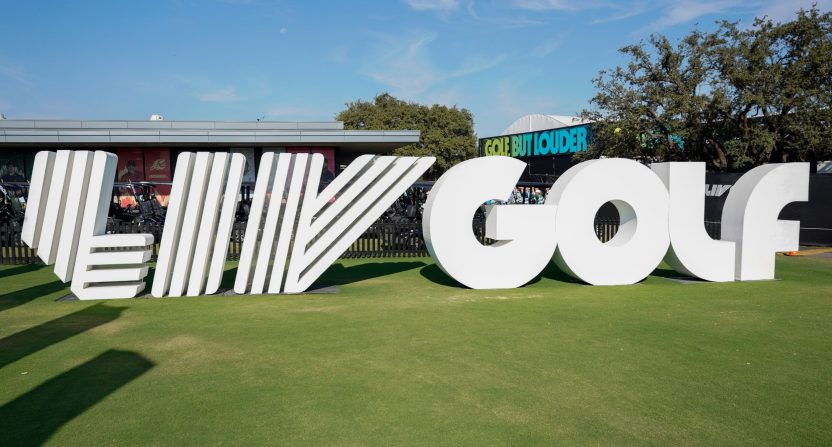

LIV Golf officially filed for bankruptcy this week, hoping to rebuild a self-sustaining world golf tour from the ashes of Saudi Arabia’s most infamous sportswashing attempt.
Ever since the Saudis pulled their billions of dollars in funding, the tour has faced an existential crisis. As its 2026 season concluded, it canceled its team championship event and ended the campaign early. LIV then laid off most of its workforce before ultimately filing for bankruptcy.
While LIV Golf CEO Scott O’Neil has hyped a potential new investor that could save the tour, the reality paints a far different picture.
According to the bankruptcy filing, LIV has until Oct. 13 to meet several criteria for BC Partners to make their investment official. At least half the players with outstanding claims against LIV, including top stars like Jon Rahm and Bryson DeChambeau, must sign on to the new agreement in order to make it valid.
Incredibly, LIV doesn’t just owe money to players it forked over millions of dollars to in order to join its rebel tour. It also owes money to other people and entities, including YouTube content creator Rick Shiels. LIV still owes him $1.4 million as an ambassador, in one of the clearest signs of the wasteful spending that doomed the league.
Another element that doomed LIV 1.0 is that it could never produce enough revenue on its own, outside of the Saudi PIF, to become sustainable. And that’s seen in the television revenue detailed in the bankruptcy filing, or lack thereof.
LIV had 20 broadcast deals, including in the United States of America with Fox Sports. However, it accounted for only 5% of overall revenue, amounting to approximately $10 million, according to Sean Zak of Golf.com. By comparison, the PGA Tour’s current media deals with NBC, CBS, and ESPN are reportedly valued at $700 million annually.
The main reason LIV Golf was never financially sustainable: just 5% of revenue coming from TV money.
In recent years, the PGA Tour has seen as much as 67% of its core revenue come from TV money.
Nothing matters more than eyeballs and getting a broadcaster to want them. pic.twitter.com/pR2sHQGa3o
— Sean Zak (@Sean_Zak) September 9, 2026
LIV Golf moved to Fox Sports from The CW in 2025. And although an exact number was never disclosed, the rights fee was believed to be quite small. These numbers from the bankruptcy filing would confirm that.
Television revenue is paramount for any sports league, whether it’s the PGA Tour, the NFL, LIV, or anything in between. And if LIV couldn’t attract any serious revenue from networks (or eyeballs to their telecasts) before their bankruptcy, when they had all the stars and were acting like conquering the golf world would be easy, what will a scaled-back version seriously be able to draw?
Sure, LIV 2.0 may come to being if everything goes right over the next month. But without a real audience and without any real television revenue, it looks like it would be merely a stay of execution rather than a legitimate comeback.

About Matt Yoder