
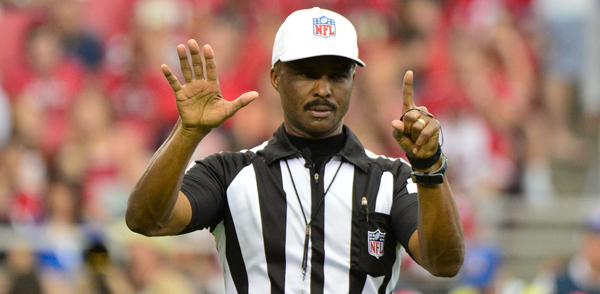
CBS NFL rules analyst Mike Carey has come under plenty of fire over the past few years, and some of it’s deserved. His TV performances have often been stiff, he’s sometimes been slow to weigh in, and he hasn’t yet consistently figured out how to work within the demands of the medium and provide authoritative insight. He’s also had his opinion proven wrong on some high-profile stages, including during the Super Bowl. However, Carey was found to be successful on 36 of 44 calls this year (with no opinion given on a further four), and he’s received substantial public support from CBS Sports chairman Sean McManus. Moreover, even those cases where he was wrong aren’t definitively so; Carey spoke to Jenny Vrentas of The MMQB before the Super Bowl and raised an interesting point, wondering why everyone seems to agree with the eventual rulings from the New York replay office.
I know what [a hit rate] is because I have been inundated with it. There are plays I would like to have back; there are a couple days I would like to have back, for that matter. But not unlike all the other experts who chose who was going to win the AFC Championship, I make errors. Everybody makes errors. But when you look at the record, I am happy with how I have synced up with New York’s reviews of plays. We’re about 90 percent [matching with the league office]. It is curious though, that whenever I disagree, in this day of high criticism of officiating, and New York is right 100 percent of the time? But I’m happy to be the lightning rod for the officials on the field.
There are a couple of valuable points there from Carey. First, it’s worth noting that rules and replay analysis tends to be judged more harshly than other analysis on a broadcast, as it has more black-and-white outcomes; it’s very clear whether the eventual call agrees with the rules analyst or not, but while Phil Simms may take plenty of mockery for some of his in-game comments, it’s harder to definitively prove them wrong. It’s also notable that we tend to forget pretty fast when other black-and-white outcome predictions (preseason, week-by-week and playoff picks) go wrong. The most interesting thing here, though, might be the more existential question of what we actually want Carey to predict.
In a perfect world, this would be simple. There would be a clear call, Carey would identify what it was, and the league would then confirm it, making everyone look good. Real life’s a little messier, though, especially when it comes to the NFL’s rulebook and some of its wonky definitions and interpretations, such as helmet-first hits that aren’t helmet-first hits and catches that aren’t catches.
In those unclear cases, what do we want to see from Carey? Are we expecting him to use his knowledge from his time as a referee to determine what the call should be? Or are we expecting him to read the minds of the officials in the league office and predict what call they’ll actually make? It’s probably more the latter, as that’s more relevant to viewers than Carey’s own opinion, but it’s worth noting that these calls are not always black-and-white. Even when Carey’s commentary doesn’t line up with the final decision, that doesn’t necessarily make it “wrong.” A perfect case came from the Super Bowl, where Carey’s position on the Jerrico Cotchery non-catch seemed more logical than the eventual call. Thus, there’s a case for him to use opinion as well, especially on complicated calls where he doesn’t have a clear sense of just what the league will decide.
None of this means all the criticism of Carey is unfounded, either. He has made big mistakes in high-profile situations, and he’s been too slow to figure out a play and the likely ruling sometimes. Perhaps the even bigger problem is that he doesn’t always explain himself well; the stats show that Carey’s been right numerous times, but he doesn’t often seem confident, and he doesn’t always get across the nuances of how the rulebook relates to a situation. There’s still definitely plenty of growth we could see from him. However, just judging Carey on a wrong or right basis doesn’t tell the whole story, given the complexities of the NFL’s rulebook and the frequent inconsistencies of its officials.
[The MMQB]


Comments are closed.